Framework — What It Takes for a Breakthrough to Happen
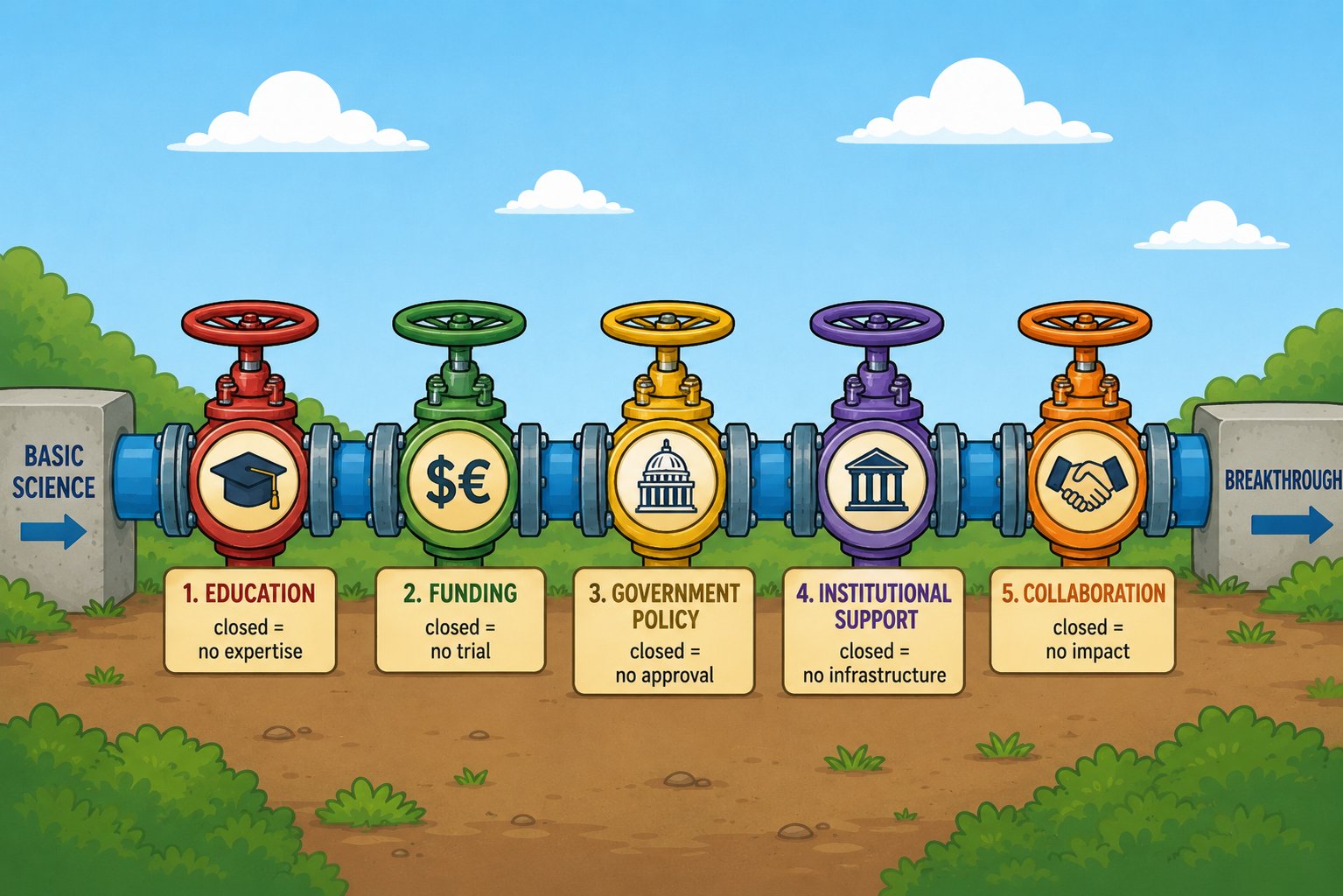
This post explores the full ecosystem required for a scientific breakthrough to occur. It is not just the science itself, but the human, financial, institutional, political, and cultural conditions that make it possible.
A breakthrough is never just a scientific event. It is the output of a system. And like all system outputs, it can only be understood by studying the system that produced it — not just the moment of output itself. What follows is a framework for doing exactly that, organized around nine questions that together map the full ecosystem a breakthrough requires.
Education
Before a breakthrough can happen, the people capable of producing it have to exist. That means asking: what kind of education produced the researchers who did this work? Was it narrow and specialized, or did it cross disciplines? Were they trained to follow consensus or to question it? The educational pipeline is the furthest upstream variable in any breakthrough story — it determines the shape of the talent pool a generation before the science happens. Institutions that produce paradigm-shifting researchers tend to share certain features: they reward intellectual risk, they expose students to unsolved problems early, and they create conditions for genuine mentorship rather than credential processing.
The pipeline from student to independent researcher is long — often 15 or more years from undergraduate enrollment to a tenured position — and each stage selects for different qualities:
| Stage | Duration | What Is Learned |
|---|---|---|
| Undergraduate (BSc/BA) | 4 years | Foundational biology, chemistry, physics, math, statistics; early lab exposure |
| PhD | 4–7 years | Deep expertise in one area; how to design experiments, handle failure, write, and publish |
| Postdoctoral fellowship | 2–6 years | Broadening skills; building publication record; developing independent research agenda |
| Junior faculty / PI | 5–10 years | Building a lab, training students, competing for grants, establishing reputation |
| Senior/tenured researcher | Ongoing | Accumulated expertise, networks, credibility to take larger risks |
What Education Must Produce
Technical knowledge alone is insufficient. Every researcher entering this pipeline should arrive with a working foundation across multiple disciplines — not mastery, but enough literacy to collaborate across fields and read primary literature outside their specialty:
Beyond the base, breakthrough researchers need a set of capacities that formal coursework rarely teaches explicitly:
- Statistical and experimental design literacy — to design studies that will actually produce valid results, not just publishable ones
- Writing and communication skills — grants, papers, and talks determine whether ideas get funded and recognized; a researcher who cannot communicate their work clearly will not have it built upon
- Failure tolerance — most experiments fail; researchers who cannot emotionally process that leave science, taking years of training with them
- Breadth alongside depth — many breakthroughs come from applying tools from one field to a problem in another; narrow specialists miss these connections
- Mentorship quality — who trained the researcher matters enormously; most breakthrough scientists trained under other breakthrough scientists. We are a product of our environment, and the lab a PhD student joins may matter more than the institution they attend
The Structural Problem
The PhD and postdoctoral pipeline is widely recognized as broken in several critical ways. The system trains more researchers than it can sustain, then loses many of its best people — not to failure, but to economic reality:
- US biomedical PhD students earn approximately $30,000–$40,000 per year, often in high cost-of-living cities like Boston, San Francisco, and New York — cities where that salary covers rent only with difficulty [1]
- Postdocs earn approximately $55,000–$70,000 per year, often for five to eight years, with no job security, no benefits parity with faculty, and no guarantee of a position at the end [2]
- The tenure-track faculty job market is extremely competitive — in many biomedical fields, roughly 200 PhDs are produced per faculty position created per year [3]
- Many researchers leave academia not because they lack talent, but because the economic conditions are unsustainable — particularly for those with student debt, families, or obligations that a postdoc salary cannot accommodate [4]
- Underrepresented groups — women, minorities, first-generation students — leave at higher rates at every transition point in the pipeline, a pattern that compounds over decades into a research workforce that is less diverse than the talent pool it draws from [5]
This is a structural threat to future breakthroughs. The pipeline filters out people based on economic endurance rather than scientific potential. That is not a selection for talent — it is a selection against anyone who cannot afford to wait.
Sources
[1] NIH NRSA stipend levels and institutional salary data; see also surveys conducted by the National Postdoctoral Association and Future of Research.
[2] NIH Kirschstein-NRSA postdoctoral stipend scales; National Postdoctoral Association 2023 Institutional Policy Report.
[3] Alberts et al., "Rescuing US Biomedical Research from Its Systemic Flaws," PNAS, 2014; National Science Foundation Survey of Earned Doctorates.
[4] Future of Research, "Decrypting the Postdoc Experience," 2020; Nature survey on postdoc satisfaction and career intentions.
[5] National Academies of Sciences, Engineering, and Medicine, "The Science of Effective Mentorship in STEMM," 2019; NSF STEM workforce diversity reports.
A Proposed Solution: Build the Conditions Into the University Itself
The standard policy responses to this problem — raise stipends, cap postdoc duration, create more faculty lines — are correct in principle and politically stalled in practice. They require money that universities claim not to have and federal will that has not materialized. A more tractable approach starts from a different premise: instead of waiting for the system to fix itself, build the conditions researchers need into the university as an ongoing project.
The core idea is simple. Researchers need housing, food, healthcare, and childcare. These are expensive to provide in cities. But a university already has architects, engineers, artists, builders, educators, and students who need meaningful project-based work. The solution is to make providing these things a university project — not a charity, not an administrative line item, but a living curriculum that students are proud to be part of.
Engineering and architecture students design and help construct small, sustainable housing units — tiny homes and communal living spaces built from recycled and locally sourced materials, secured through a dedicated course where students work directly with local companies and suppliers. Artists contribute to the design of shared spaces. Early education students staff a childcare cooperative for a manageable shift per week, learning their field by practicing it. A separate course has students whose job is to secure resources, write grants, and build the partnerships that keep the project financially viable.
The communal design matters: shared kitchens, common areas, and gardens reduce the per-person cost of living while building the kind of cross-disciplinary social density that produces unexpected collaborations. These are not dormitories — they are small communities, designed intentionally, built and maintained by the university population itself.
What makes this work is that it becomes something the university can be proud of and publicly celebrate. It is not a subsidy — it is a demonstration. It shows that an institution committed to producing the next generation of breakthrough researchers is willing to invest in the conditions those researchers need to survive long enough to do the work. Set a budget. Start small. Build slowly. If parts of it fail, learn from them. The goal is not perfection — it is a culture where students, faculty, and researchers understand that making the university better is part of what it means to be here.
Who Is Involved
Breakthroughs are rarely the product of a single researcher working alone. They are the product of a network — and the composition of that network matters enormously. Who is at the table? What disciplines are represented? Are the key players from academia, industry, government, or some combination? How did they find each other, and what kept them working together through the long periods when results weren't coming? The answer to "who is involved" also includes who is notably absent: breakthroughs often happen at the edges of established fields precisely because the people doing the work weren't fully socialized into the assumptions those fields take for granted.
The People, and the Traits They Share
A breakthrough requires scientists at varying levels of seniority and with very different personalities — there is no single profile. But across the biographies of researchers behind major breakthroughs, a consistent set of traits keeps showing up, regardless of the field or the personality type layered on top of them.
- Obsessive focus with genuine curiosity. Schett spent over a decade studying B cells and autoantibodies before the CAR-T idea ever emerged. The curiosity has to be real, not performative — researchers chasing prizes or prestige tend to play it safe, and breakthroughs rarely come from playing it safe.
- High tolerance for ambiguity and failure. The vast majority of experiments in a breakthrough lab fail. Years can pass with no positive result. Researchers who need constant validation tend to leave the field before the work pays off.
- Willingness to be wrong publicly. Publishing negative results, revising hypotheses, and acknowledging failure in grant renewals all require real ego strength and intellectual honesty — qualities that are easy to claim and hard to actually sustain under career pressure.
- Cross-domain thinking. Musunuru is a cardiologist who applied gene editing — a tool from rare disease biology — using LNPs (lipid nanoparticles, a delivery technology developed for infectious disease vaccines) to treat a metabolic enzyme defect. Schett applied oncology's most powerful cell therapy to rheumatology, a field it had nothing to do with originally. The ability to pattern-match across fields is repeatedly the actual source of major breakthroughs, more often than any single field's internal progress.
- Networking and relationship-building. Neither breakthrough happened in isolation. Both involved large teams, institutional partnerships, and years of relationship-building within scientific communities. Introverts can absolutely succeed in this environment, but isolation kills breakthroughs — the work simply doesn't happen without a network to sustain it.
- Bureaucratic endurance. The regulatory, grant, and institutional compliance demands placed on researchers are enormous. The ability to navigate all of this without losing motivation or scientific focus is a genuine, underrated skill — and one that filters out a lot of otherwise talented people.
- Ethical seriousness. Both breakthroughs raised profound ethical questions: who gets access, what are the risks, how is consent obtained — especially for a baby who cannot consent at all. Researchers who haven't seriously thought through the ethics of their own work create crises that can derail not just their own careers, but entire fields.
Government Policy
Government shapes science at every level, often invisibly. Immigration policy determines whether the best researchers in the world can work where the best labs are. Export controls determine what technologies can be shared across borders. Defense priorities redirect entire research communities. The political appetite for long-horizon, uncertain investments — the kind that basic research requires — fluctuates with administrations and budget cycles in ways that leave decade-long marks on what science gets done. Understanding a breakthrough means understanding the policy environment it grew up inside, including the policies that almost stopped it.
Regulatory Frameworks
Regulation is both the barrier and the guarantor of trust in science. Without it, patients can be harmed and public confidence collapses. With too much of it, life-saving therapies are delayed by years. Every breakthrough that reaches a patient has to pass through one of these systems.
United States (FDA)
The FDA (Food and Drug Administration) is the US agency responsible for approving drugs, biologics, and medical devices before they can be sold or used on patients.
- Standard drug/biologic pathway: an IND (Investigational New Drug application, the filing that allows human testing to begin) leads into Phase I (safety testing in a small group), Phase II (testing dosing and early efficacy in a medium-sized group), and Phase III (a large randomized controlled trial). The results are then submitted as a BLA (Biologics License Application) or NDA (New Drug Application), followed by FDA review — typically one to two years — before approval. The total timeline is often 10 to 15 years and $1–2 billion in cost.
- Accelerated pathways: Breakthrough Therapy Designation, Fast Track Designation, Priority Review, and Accelerated Approval are all FDA mechanisms that can cut these timelines significantly for serious conditions with unmet medical need.
- Expanded Access / Compassionate Use (formally an Emergency IND): used in the case of KJ — this allows a single patient to be treated outside of any formal clinical trial, and the FDA can approve it in days when a patient's life is at immediate risk.
- Post-KJ bespoke pathway (2025): a new FDA framework created for personalized gene therapies. It does not require Phase I, II, or III trials — platform-level evidence (proof that the underlying delivery technology is safe and effective in general) plus real-world evidence is sufficient. This is a significant structural breakthrough for rare disease treatment.
- IRBs (Institutional Review Boards) are independent committees, typically housed at hospitals or universities, that review all research involving human subjects — separately from and in addition to FDA oversight.
Germany / European Union
The standard approval pathway in the EU follows a similar clinical logic to the US, but runs through different institutions and a centralized authorization step. The PEI (Paul-Ehrlich-Institut) is Germany's federal regulator for biologics, vaccines, and cell therapies, while the EMA (European Medicines Agency) handles marketing authorization across the entire EU — the rough equivalent of the FDA at a continental scale:
- Standard pathway: a sponsor files a CTA (Clinical Trial Application) with the national regulator — the PEI in Germany — for the country where the trial will run. This is followed by Phase I, II, and III trials, the same staged structure as the US system. Results are then submitted to the EMA as an MAA (Marketing Authorisation Application).
- The EMA's scientific committees review the MAA and issue a recommendation, which the European Commission then converts into a single authorization valid across all EU member states at once — unlike the US, a single approval covers the entire union rather than one country. This centralized review typically takes about a year, with the full path from first trial to approval running 8 to 12 years for novel biologics.
- PRIME (PRIority MEdicines) is the EMA's accelerated-pathway equivalent to the FDA's Breakthrough Therapy Designation — early and enhanced scientific support for medicines that target a significant unmet medical need.
- Conditional Marketing Authorisation allows approval based on less complete data than normally required, for medicines addressing unmet needs, with the requirement that the company complete further studies post-approval — roughly analogous to the FDA's Accelerated Approval.
- Hospital Exemption Pathway (EU Regulation 1394/2007): allows academic hospitals to manufacture and administer ATMPs (Advanced Therapy Medicinal Products — therapies based on genes, tissues, or cells) to small numbers of patients on a non-routine basis, without going through full EMA marketing authorization at all. This is the mechanism that let the Erlangen team treat patients directly rather than waiting for a multi-year centralized review — the closest EU equivalent to the FDA's Compassionate Use pathway, though grounded in a different legal logic: it exempts a specific hospital-made product from full authorization rather than granting emergency access to an otherwise-regulated one.
- Ethics committees at each university must independently approve all human research, similar in function to US IRBs.
- GDPR (General Data Protection Regulation) adds patient data protection requirements that can slow research — but also exist specifically to protect patients.
Biosafety and Dual-Use Laws
Certain research is constrained not by clinical regulation but by national security and biosafety law — rules concerned with what could go wrong if dangerous biological material or techniques were misused:
- Select Agent regulations (US) impose strict controls on pathogens that could potentially be weaponized.
- The NIH Guidelines for Research Involving Recombinant or Synthetic DNA govern what gene editing work can legally be done and at what biocontainment level.
- CRISPR germline editing — editing heritable DNA in embryos, meaning changes that would be passed on to future generations — is effectively banned or heavily restricted in most countries following the He Jiankui scandal (China, 2018), in which a researcher edited human embryos in violation of international scientific norms. KJ's therapy, by contrast, edited only somatic cells (non-heritable, body cells that don't get passed to offspring), which is precisely why it was permissible.
Intellectual Property Law
Patent law shapes the entire commercial landscape of science — determining not just who profits, but who is incentivized to fund the expensive, risky work of turning a discovery into a usable therapy:
- The Bayh-Dole Act (US, 1980) allows universities to own and license patents on inventions that were developed using federal funding. This is the legal basis that allows institutions like CHOP and Penn to license IP from NIH-funded work. Before Bayh-Dole, federally funded intellectual property largely sat unused, with no clear path to commercialization.
- Patent term: patents last 20 years from the date of filing. For biotech specifically, the long road through clinical trials and regulatory review often means only 5 to 10 years of actual commercial exclusivity remain by the time a drug reaches market — this compressed window is the underlying basis for much of the pricing pressure seen in the industry.
- Evergreening (extending a patent's effective life through minor reformulations), patent thickets (overlapping patents that make a technology hard to use without licensing several at once), and orphan drug exclusivity provisions all affect how long companies retain monopoly pricing power over a given therapy.
Immigration and Visa Policy
Often overlooked, but critical: a large fraction of America's breakthrough researchers are foreign-born. Kiran Musunuru's father immigrated from India; the Erlangen team's careers involved cross-border movement throughout Europe. H-1B (a US visa category for skilled foreign workers) and O-1 (a visa for individuals with extraordinary ability) visa processes, STEM OPT extensions (Optional Practical Training, which allows foreign STEM graduates to work in the US temporarily after their degree), and green card backlogs all directly affect whether the best researchers in the world can work in a given country. Restrictions in this area have measurable negative effects on national research output — talent that cannot get a visa simply does its breakthrough work somewhere else.
Problems with the FDA, and a Proposed Solution
The following is my own opinion, not a neutral summary of the regulatory landscape described above.
One of the clearest recent illustrations of how regulation interacts with public trust came out of the COVID-19 pandemic. Under the PREP Act (Public Readiness and Emergency Preparedness Act), the federal government granted COVID-19 vaccine manufacturers broad liability protection — immunity from most lawsuits related to vaccine injury, with claims instead routed through a federal compensation program called the CICP (Countermeasures Injury Compensation Program) rather than the courts. That program has historically compensated only a small fraction of the claims filed against it. Whatever one believes about the vaccines themselves, this structure illustrates a real tension: emergency-use frameworks that move fast by also limiting who can be held accountable, and routing the injured through a compensation system that has been slow and difficult to actually collect from. A regulatory system that the public is meant to trust needs both speed and a credible path to accountability when something goes wrong — not one in place of the other.
That tension points to a more general problem. The FDA's core process is often inefficient in exactly the cases where it matters most: when a treatment or drug is already known, from real-world use elsewhere, to be safe and effective. The same multi-year, multi-billion-dollar pathway designed to catch genuinely unknown risks also gets applied, by default, to therapies that other countries have already used safely on large populations for years. In those cases the system isn't protecting patients — it's just slow.
My proposed solution is to build a second pipeline specifically for this category: drugs and treatments with an established safety and efficacy record from regulators in peer countries — the EMA, the UK's MHRA, Japan's PMDA, and similar bodies — should be eligible for an expedited US review that leans on that existing real-world evidence rather than restarting the full Phase I–III process from zero. The infrastructure for this already exists in pieces — reciprocal review arrangements and reliance pathways are used selectively today — the proposal is to make this the default route for any therapy with a multi-year safety record abroad, not a rare exception.
The same logic should run in the other direction. Many countries — across the EU and elsewhere — have already banned specific food dyes and additives on safety grounds that the US has not acted on, despite the underlying science being available to American regulators too. Those bans should be implemented in the US on a similarly expedited basis: if a substance has already been restricted abroad on safety evidence, that evidence should be sufficient to trigger fast review here, not just abroad.
I don't think this is purely a regulatory or technical problem, though. Part of why these bans haven't happened in the US is that large food and beverage corporations that profit from cheap, low-quality ingredients have significant political power, and changing food safety standards would mean confronting that directly. That, in turn, runs into a deeper structural issue: corporate concentration and political spending have become deeply intertwined in a way that makes it hard to pass policy that goes against the interests of the largest incumbents in a given industry — food, pharmaceuticals, or otherwise. Addressing that seriously would likely require some combination of antitrust enforcement against firms that have become too dominant, and campaign finance reform — caps on political donations and limits on corporate lobbying — to reduce the degree to which concentrated industries can shape the rules that govern them.
I recognize this is a large ask, and reasonable people disagree about how realistic or how desirable that level of structural reform actually is. But my honest view is that on the narrower question — should it be harder for a small number of large companies to keep selling ingredients that other wealthy countries have already restricted — most Americans, across the political spectrum, would probably agree. The harder part is everything downstream of that agreement: building the political coalition and institutional will to actually act on it.
In the meantime, the solution within an individual's own reach is smaller, but not nothing: promote health where you actually have influence, invest in your community, help the people around you, and make a genuine effort to interact with people outside your usual social bubble. None of that substitutes for structural reform — but it's the part of the system that doesn't require waiting on Congress. Ideally, the larger changes happen too, and the US ends up with food and drug safety standards closer to what much of Europe already has.
Funding
Money shapes what science gets done, and the source of that money shapes it further. Public funding through agencies like NIH or NSF operates on different incentive structures than private philanthropy, venture capital, or industry R&D budgets. Each comes with its own time horizon, risk tolerance, and definition of success. The question is not just whether funding existed, but what kind, from whom, on what terms, and with what strings attached.
The Core Tension
Scientific breakthroughs almost universally begin with public money and end with private money. The basic research that eventually cures a disease is almost never commercially attractive at the outset — it is too risky, too slow, and the payoff is too uncertain. That is precisely why governments fund it. Once the risk has been reduced enough to see a viable product, private capital rushes in.
Public Funding
Public funding flows through grant mechanisms that differ by country but share a similar underlying structure. In the United States, the dominant channels are:
- NIH (National Institutes of Health) — the world's largest funder of biomedical research, at roughly $45 billion a year in normal years.[A] Mechanisms like R01 grants (investigator-initiated research), U01 grants (cooperative agreements), and P01 grants (program project grants supporting multiple related research projects) fund the majority of academic lab science in the US.
- NSF (National Science Foundation) — funds more basic and fundamental science; less clinical in focus, but foundational to fields that later become clinically relevant.
- ARPA-H (Advanced Research Projects Agency for Health) — a new agency, created in 2022 and modeled on DARPA, that funds high-risk, high-reward research that would not pass standard NIH review because it is too speculative.
- DOD/DARPA — the Department of Defense and its Defense Advanced Research Projects Agency have historically funded transformative biomedical work when it overlaps with national security, including the mRNA vaccine platform, wound healing research, and neuroscience.
In Germany, the equivalent channels are:
- DFG (Deutsche Forschungsgemeinschaft, the German Research Foundation) — the core public funder, supporting both individual grants and large collaborative research centers known as SFBs (Sonderforschungsbereiche). Georg Schett's IMMUNOBONE SFB ran for roughly 15 years.
- BMBF (Federal Ministry of Education and Research) — mission-oriented applied research funding.
- ERC (European Research Council) — a pan-European, highly competitive funder offering Starting, Consolidator, and Advanced Grants that support individual researchers across different career stages.
- Helmholtz Association, Max Planck Society, and Leibniz Association — institutional public funders for independent research organizations that operate outside the traditional university system.
How to Get It
The grant-seeking process follows a fairly consistent sequence regardless of country:
- A researcher generates preliminary data, usually unfunded or drawn from a prior grant.
- They write a grant application describing the scientific question, methodology, budget, and team.
- The application is peer-reviewed — by a study section at the NIH, or an expert panel at the DFG or ERC.
- It is scored on significance, approach, innovation, investigator quality, and research environment.
- It gets funded only if the score is competitive — typically the top 10–20% for NIH, and the top 10–15% for ERC.
- A typical grant cycle runs 3 to 5 years, after which the researcher must reapply and report results.
- Grant writing itself is a full-time skill. Senior researchers at top institutions often employ dedicated grant writers and spend 30–40% of their working time on funding applications rather than on the research itself.
Public funding pays for salaries — graduate students, postdocs, lab managers — along with equipment, consumables, animal care, sequencing costs, publication fees, and conference travel. It also pays indirect costs: the overhead an institution charges for building maintenance, safety, compliance, and IT, typically adding 50–70% on top of direct research costs in the US.
Even with all of this, a gap remains. In 2023, US universities contributed roughly $27 billion of their own institutional money — drawn from endowments and clinical revenue — to cover research costs that federal grants did not reimburse.[B] Public funding is necessary, but it is never sufficient on its own.
Private Funding
Private funding enters in several distinct layers, each with a different relationship to risk and timing.
Philanthropic and nonprofit funding: foundations like the Gates Foundation, the Wellcome Trust, the Howard Hughes Medical Institute (HHMI), and disease-specific charities such as the Lupus Research Alliance or the National MPS Society fund work that the NIH typically won't — often because it's more speculative or has a longer time horizon than a standard grant cycle allows. HHMI is a particularly notable model: it funds people, not individual projects. Its investigators receive sustained funding without the pressure of annual renewal, which enables genuinely longer-horizon thinking. In KJ's case, the Orphan Disease Center at Penn/CHOP was partly donor-funded.
Venture capital: VC money tends to enter once there is proof-of-concept in humans, or sufficiently strong animal data. Kyverna Therapeutics, for example, was founded in 2020 and immediately backed by Gilead Sciences and Vida Ventures — before Schett's first patient had even been treated. A typical biotech VC trajectory runs through a Series A round ($30–100 million), a Series B round ($100–300 million), and then either an IPO or an acquisition. VC money moves faster and more flexibly than a grant, but it comes with equity dilution and real investor pressure to show results on a commercial — not a scientific — timeline.
Pharma and industry funding: large pharmaceutical companies like Novartis, Bristol Myers Squibb, and Janssen typically don't fund basic research directly. Instead, they license or acquire a therapy once its underlying pathway has already been validated by someone else. Industry money is the largest funding source in absolute dollar terms, but it is also the last to arrive — it monetizes breakthroughs that the public and philanthropic sectors already created.
The lesson from both of the breakthroughs discussed throughout this framework is consistent: Schett's CAR-T work was entirely publicly funded, through the DFG and FAU. Musunuru's CRISPR work was primarily NIH-funded, with in-kind industry support layered on top. The private sector commercializes what the public sector proves. Neither one works without the other.
What Enables the Scientist
Even with education, collaborators, supportive policy, and funding in place, a researcher still needs the specific conditions that allow them to do their best work. This means access to equipment and infrastructure. It means institutional support — or at minimum, institutional tolerance — for unconventional lines of inquiry. It means time: the ability to think slowly in a system that increasingly rewards speed. It means data, computational resources, model organisms, clinical access, and all the other inputs that convert a good idea into testable science. The enabling conditions for a scientist are granular and specific, and their absence — even one of them — is often enough to stop a breakthrough that was otherwise ready to happen.
What Scientists Need to Live — The Human Infrastructure
Breakthroughs require years of sustained, focused effort. The conditions of daily life for researchers directly affect whether that effort is even possible — and this layer is consistently underweighted relative to the scientific infrastructure discussed above.
Compensation
Graduate students and postdocs are chronically underpaid relative to the cost of living near major research universities — Boston, San Francisco, Philadelphia, New York, Berlin. A postdoc at Penn earning $60,000 in Philadelphia is just survivable; that same salary in San Francisco or New York is poverty-level. This systematically filters out researchers who don't have family money or other outside support, regardless of their scientific potential.
Housing
Research clusters around a handful of expensive cities. That clustering isn't arbitrary — geographic proximity to peers, infrastructure, and institutions matters enormously for collaboration. But housing cost is a genuine barrier layered on top of that necessity. Several European countries, Germany in particular, have historically had lower housing costs than US research hubs, which partly explains why talented researchers there stay in the academic system longer.
Healthcare
In the US, researchers on training grants or short-term postdoc appointments often have unstable or inadequate health insurance. This creates real personal risk and becomes a recruitment and retention problem for the institutions that depend on these researchers. German researchers in academic medicine, by contrast, receive standard statutory health insurance as a normal part of their employment.
Time and Mental Health
The academic research environment has a well-documented mental health crisis. A 2018 Nature survey found that graduate students are roughly six times more likely to experience depression and anxiety than the general population.[G] The causes are not mysterious: isolation, long hours, uncertain career prospects, power imbalances with advisors, and the constant lived experience of failure. Breakthroughs require sustained creative effort, and sustained creative effort is incompatible with chronic stress and burnout. Institutions that invest in mental health support, reasonable working hours, and good mentorship produce more breakthroughs, not fewer — this is not a tradeoff between researcher wellbeing and scientific output, it is a precondition for it.
Childcare and Family
Academic science's career timeline — roughly age 22 to 40, from PhD entry through tenure — overlaps almost exactly with peak family-formation years. Women leave research at higher rates than men at every career transition along that timeline, with childcare consistently cited as a leading reason. Institutions that provide on-site childcare, real parental leave, and clock-stopping tenure policies — pausing the tenure clock during parental leave rather than letting it run regardless — retain more talent than institutions that don't.
Transportation
Being near a research cluster matters. Most major breakthroughs come from a relatively small number of geographic nodes — Boston/Cambridge, the San Francisco Bay Area, Philadelphia, San Diego, London, Berlin, Munich, Tokyo. But within those nodes, commute time and reliable transit determine who can actually participate day to day. Researchers who spend three hours a day commuting have measurably less time and mental bandwidth for the informal conversations — in hallways, at lunch, after seminars — that often generate the ideas behind breakthroughs in the first place.
What Rewards the Science
Science is done by human beings, and human beings respond to incentives. What does the reward system look like for the kind of science that produces breakthroughs? Publication metrics, grant renewal criteria, tenure clocks, prize structures, peer recognition — all of these shape what researchers pursue and what they avoid. Fields where the reward system is tightly aligned with short-term, measurable outputs tend to underinvest in the foundational work that makes long-term breakthroughs possible. Understanding what a scientific community rewards — and what it ignores or punishes — tells you a great deal about where its breakthroughs are likely to come from, and where they won't.
How Should Scientists Be Recognized?
The Current System
Academic science rewards a fairly narrow set of outputs: publications, especially in high-impact journals like Nature, Science, NEJM, and Cell; citations, meaning how often a researcher's work is referenced by others; grant funding, where total dollars raised is often used as a rough proxy for scientific importance; prizes, such as the Nobel, the Leibniz, the Lasker, or the Breakthrough Prize; and tenure and promotion decisions, which are themselves largely based on the metrics above.
What this system does well is create strong incentives to produce novel, publishable findings. What it does badly is more extensive:
- It rewards positive results over negative ones. Failed experiments rarely get published, which means the field as a whole doesn't learn from them — the same dead end can get rediscovered by different labs over and over.
- It rewards quantity over quality. The "publish or perish" pressure pushes researchers to slice findings into the smallest publishable units rather than waiting to present a complete, well-tested body of work.
- It rewards individual recognition over team science. Most major breakthroughs involve large teams, but prizes and tenure cases are built almost entirely around lead authors and principal investigators.
- It does not reward mentorship, teaching, data sharing, reproducibility, or public communication — all of which are critical to a healthy scientific ecosystem, but none of which show up meaningfully on a CV.
- It creates perverse incentives around flashy findings. Schett's first CAR-T paper was a five-patient study — tiny by ordinary statistical standards — but it was published in Nature Medicine because the result was so dramatic. The pressure to publish early and publish big can lead to overstated claims that outrun the actual evidence.
Better Models
- HHMI's investigator model: fund people, not individual projects; no annual renewal; genuine tolerance for failure. This model produces a disproportionate share of major breakthroughs relative to its size.[F]
- Prize-based funding: DARPA-style challenges that award a prize for achieving a clearly defined outcome, rather than for publishing a paper about it.
- Explicit reproducibility rewards: some journals and funders now give real credit for replication studies and for the work of preparing data to be shared, rather than treating that work as invisible.
- Team science credit: newer models for attributing contributions fairly across large research teams, rather than collapsing the credit onto a single lead author.
How the Science Is Shared
A discovery that isn't communicated isn't useful. The mechanisms by which science moves — from lab notebooks to preprints to peer review to clinical translation to public knowledge — determine how quickly a breakthrough can compound into further breakthroughs, and how broadly its benefits can spread. Open-access publishing, conference culture, data-sharing norms, science communication to non-specialist audiences: all of these are part of the system. So is the question of language — which scientific communities can read and build on each other's work, and which are siloed by geography, institution, or field-specific vocabulary.
Information Sharing — How Science Should Communicate
The Traditional System and Its Problems
The traditional system works like this: researchers publish in peer-reviewed journals. Those journals rely on peer review performed unpaid by volunteer experts in the field, and then charge institutions subscription fees to access the resulting papers — often $30 to $50 per article for someone unaffiliated with a subscribing institution, or millions of dollars a year for institutional subscriptions covering an entire university. The research itself was frequently funded by taxpayers in the first place. This model is widely regarded, across the scientific community, as broken.
The Open Access Movement
Open access, or OA, mandates that publicly funded research be freely available to anyone, not just subscribers. In the US, the NIH now requires that all NIH-funded research be deposited in PubMed Central within 12 months of publication.[C] The EU mandates similar requirements for its own publicly funded research. "Gold OA" — meaning immediate free access from the moment of publication — requires researchers themselves to pay article processing charges, or APCs, often running $3,000 to $5,000 per paper. This shifts the cost from the reader to the author, which in practice disadvantages labs that don't have the spare budget to absorb that fee.
Preprints
Platforms like bioRxiv and medRxiv allow researchers to post papers before formal peer review — making the findings instantly available to the world rather than waiting months or years for the journal process to complete. The COVID-19 pandemic normalized this practice at scale: critical findings, including early mRNA vaccine data, were shared via preprint months before formal publication, because the speed mattered more than the formal credentialing process. The risk is real — preprints can amplify findings that later fail peer review, sometimes after they've already shaped public understanding or policy. The benefit is also real: speed, and a meaningful democratization of who gets to see new findings first.
Data Sharing
The NIH increasingly requires researchers to share their raw underlying data, under a Data Management and Sharing Policy that took effect in 2023. This is genuinely good for reproducibility and for enabling cross-lab analysis that wouldn't otherwise be possible. But it creates real burdens in practice: preparing and documenting data so that it's actually usable by someone outside the original lab takes significant time and resources that aren't always funded separately. There are also legitimate patient privacy concerns — HIPAA in the US, GDPR in the EU — that have to be navigated carefully, especially for clinical data tied to identifiable individuals.
Conference and Informal Sharing
The informal scientific conference is one of the most important innovation environments in existence, even though it rarely gets credited as part of the formal information infrastructure of science. The ASGCT conference in New Orleans in May 2025 was where Musunuru first presented KJ's case to the world — before the paper had even been formally processed through a journal. Hallway conversations, poster sessions, and informal dinners at conferences generate collaborations, data-sharing agreements, and the cross-pollination of ideas that no formal publication can fully replicate. Restricting conference travel, which is often one of the first things cut in a budget tightening, has direct and measurable negative effects on innovation — it isn't a discretionary perk, it's part of how science actually moves between people.
Who Profits and What Is Owned
Every breakthrough eventually encounters the question of intellectual property. Who owns the patents? Who licensed the underlying technology, and on what terms? What does that mean for who can manufacture the resulting therapy, at what price, and in which markets? The political economy of a breakthrough — who captures its value, and how that value is distributed — is as much a part of its story as the science itself. Ownership structures don't just affect equity; they affect what follow-on research gets done, because the incentive to invest in further development is shaped by who stands to benefit from it. A framework for understanding breakthroughs has to reckon with this dimension honestly, even when the answers are uncomfortable.
How Intellectual Property Should Work
The Core Tension
IP law exists to incentivize investment in translation — no company will spend a billion dollars developing a drug if a competitor can simply copy it the moment it works. But IP also restricts access: a patented drug that costs $500,000 per patient is inaccessible to most of the world, regardless of how well it works. Getting this balance right is one of the most consequential policy questions in science, and it doesn't have a clean answer.
University Tech Transfer
Under the Bayh-Dole Act,[E] universities own the IP that arises from federally funded research and can license it — exclusively or non-exclusively — to companies. They collect royalties on that licensing and typically share a portion with the original inventor. This system has real problems: universities sometimes over-patent defensively, creating patent thickets that slow down follow-on research rather than protecting it; licensing terms can be restrictive enough to block access in low-income countries entirely; and inventor-share rules vary widely between institutions — at some, inventors receive 30–50% of net royalties, which creates a strong personal financial incentive that can subtly distort which research directions get pursued.
Open-Source and Patent Pools
Some researchers and institutions deliberately choose not to patent at all, or to place their patents into pools offering royalty-free licensing for developing countries. The COVID-19 pandemic produced C-TAP, the WHO's COVID Technology Access Pool, which attempted to pool vaccine IP across manufacturers — largely unsuccessfully, since the major vaccine makers declined to participate. The underlying tension between IP protection and global health equity remains unresolved.
The CRISPR Patent Wars
The base-editing platform underlying KJ's therapy derives from CRISPR technology, and the most valuable patent dispute in the history of biotech has been fought over exactly that technology — between the Broad Institute (Harvard/MIT, represented by Feng Zhang) and the University of California, Berkeley (represented by Jennifer Doudna and Emmanuelle Charpentier). Billions of dollars in licensing revenue depend on the outcome of who holds which patents. This kind of IP warfare is a direct cost to science in its own right — it diverts resources into litigation, creates ongoing licensing uncertainty for anyone trying to build on the technology, and can block entire research directions while the dispute remains unsettled.
How Commercial Returns Should Be Managed
The Pricing Problem
CAR-T therapies for cancer currently cost $400,000 to $500,000 per infusion.[D] If a CAR-T therapy for autoimmune disease is approved and priced similarly, the total addressable market is enormous — lupus alone affects roughly five million people globally — but the therapy would be financially out of reach for the vast majority of patients worldwide, and financially catastrophic even within well-insured health systems.
KJ's therapy, by its very nature, has no market at all — it was built for one person. The cost of developing it was absorbed by NIH grants and in-kind industry contributions rather than recovered through sales. As bespoke gene therapies like this become more common, they will raise profound and largely unresolved questions about who pays and who gets access.
Models for Managing Returns
- Differential pricing: charging more in wealthy countries and less, or nothing, in low-income countries. Some vaccine manufacturers have used this model; it is broadly resisted by the rest of the pharmaceutical industry on IP-protection grounds.
- Outcomes-based contracting: paying for a treatment only if it actually works. Several gene therapy companies are piloting this with insurers — a model that is especially important for one-time curative therapies, where the clinical benefit can span decades but the payment is traditionally demanded entirely upfront.
- Government negotiation: in Germany, under the AMNOG process, pharmaceutical companies must negotiate price with the government based on the therapy's demonstrated added therapeutic value. This produces substantially lower prices than the US sees for the same drugs. The EU, more broadly, has more negotiating leverage than the fragmented, multi-payer US system.
- A public option for publicly funded IP: the argument that if taxpayers funded the basic research behind a therapy, taxpayers should see some benefit reflected in its eventual pricing. No such mechanism currently exists in the US — drugs developed entirely on NIH funding can be, and routinely are, priced with no reference at all to their development costs.
Collaboration vs. Competition
Every breakthrough exists somewhere on a spectrum between researchers working together and researchers racing each other. Both forces are present in every breakthrough story, and the question worth asking isn't which one is better — it's how a given field balances them, and what that balance costs.
Why Both Are Necessary
Competition drives urgency, quality, and efficiency. Knowing that another lab is working on the same problem motivates researchers to work harder and faster, and it provides a real check on sloppy science — your competitor will catch your errors, because they have every incentive to look for them.
Collaboration enables scale, cross-disciplinary synthesis, and the pooling of resources that no single lab possesses on its own. KJ's therapy required CHOP clinicians, Penn geneticists, IGI safety scientists, and Danaher manufacturing engineers, all working together. No single group had all the pieces required to make it happen.
The Dysfunction of Pure Competition
The current system is heavily competitive in ways that actively damage science rather than improving it:
- Researchers routinely withhold data and reagents from competitors until publication, which slows down the entire field rather than just the individual lab being protective.
- "Scooping" — being beaten to publication by a competitor working on the same question — is one of the most feared events in a scientific career. It can derail years of work and cost a researcher their funding, even when their own results are more rigorous than the ones that got published first.
- Grant competition is zero-sum in a way that creates perverse incentives: overselling preliminary data, understating limitations, and avoiding high-risk hypotheses that might not yield a publishable result in time for the next renewal.
- The replication crisis — the fact that many published findings in psychology, nutrition, and some biomedical fields cannot be reproduced — is partly a direct product of this competitive pressure.
The Best-Performing Model: Collaborative Competition
The highest-performing scientific environments tend to combine several things at once, rather than choosing collaboration or competition outright:
- An open internal culture within a lab or institution — weekly seminars, genuine data sharing among colleagues who aren't direct competitors.
- A competitive external environment with clear performance standards that keep the work honest.
- Consortium structures that pool pre-competitive data while still allowing competitive commercialization downstream — examples include the Alzheimer's Disease Neuroimaging Initiative (ADNI), the Cancer Genome Atlas, and the Human Cell Atlas.
- Geographic clustering that allows informal collaboration even between nominally competing groups — the Broad Institute/Harvard/MIT ecosystem, the Penn/CHOP cluster in Philadelphia, and FAU Erlangen's integrated hospital-university structure are all examples of this in practice.
Georg Schett's lab shares data with Charité Berlin and other German rheumatology centers while simultaneously competing with them for grants and prestige. Musunuru published his findings immediately in NEJM and presented at ASGCT before full commercial development had even been established — a deliberate choice to open the field rather than protect a first-mover advantage. Both of these decisions reflect the same underlying philosophy: that the field as a whole advances faster through openness, even when it comes at some personal competitive cost to the researcher making that choice.
Build the system, and the goals will follow.[1] A breakthrough is not an event. It is an outcome — the downstream product of a system that was ready to produce it.
[1] Clear, J. Atomic Habits: An Easy & Proven Way to Build Good Habits & Break Bad Ones. Avery, 2018. The central argument of the book is that systems — the processes and environments that produce behavior — matter more than goals, which are merely the outcomes those systems generate.
Sources & Further Reading
Citations marked [1]–[5] in the Education section refer to the sources immediately below that section. The following cover all other cited claims throughout this post.
[A] NIH budget (~$45 billion/year)
NIH Office of Budget. "NIH Budget." nih.gov/about-nih/what-we-do/budget
[B] $27 billion university institutional research spending gap (2023)
National Science Foundation, Higher Education Research and Development Survey (HERD), FY 2023. ncses.nsf.gov — HERD Survey 2023
[C] NIH public access / PubMed Central mandate
NIH. "NIH Public Access Policy." publicaccess.nih.gov. Effective for all NIH-funded research; 12-month deposit requirement updated under the 2023 Nelson Memo to zero embargo for federally funded research.
[D] CAR-T therapy pricing ($400,000–$500,000 per infusion)
ICER (Institute for Clinical and Economic Review). CAR-T therapy cost-effectiveness reports, 2021–2024. See also: Bach, P.B. "Drug Companies Are Making Huge Profits — And That's a Problem." STAT News, 2022. Pricing is publicly available from manufacturer list prices for tisagenlecleucel (Kymriah) and axicabtagene ciloleucel (Yescarta).
[E] Bayh-Dole Act (1980)
Pub. L. 96-517, codified at 35 U.S.C. §§ 200–212. See also: Sampat, B.N. "Patenting and US Academic Research in the 20th Century." Research Policy, 2006.
[F] HHMI investigator model and research productivity
Howard Hughes Medical Institute. "HHMI Investigators." hhmi.org/science/investigators. See also: Azoulay, P., Graff-Zivin, J., Manso, G. "Incentives and Creativity: Evidence from the Academic Life Sciences." RAND Journal of Economics, 2011 — a peer-reviewed study showing HHMI investigators produce more novel, higher-impact science than NIH-funded peers.
[G] Graduate student mental health (2018 Nature survey)
Evans, T.M. et al. "Evidence for a mental health crisis in graduate education." Nature Biotechnology, 2018; 36(3): 282–284. DOI: 10.1038/nbt.4089. nature.com/articles/nbt.4089
Author's Note
This post grew out of two separate moments that pointed me toward the same idea. The first was a conversation with a senior engineering student at Pitt, who told me that the real money in tech wasn't in the new technology itself — it was in everything built around it that makes it work and last. The second was reading James Clear's Atomic Habits, which argues that if you build the right system, the goals take care of themselves. Both said the same thing in different words: outcomes follow structure. That is what this post is trying to map.